
 Do you have one or more words or phrases you can’t stand? I do. Among them is the word “further” instead of “farther” when talking about distance. Another is common on signs in stores, saying “10 items or less” when it should read, “10 items or fewer.”
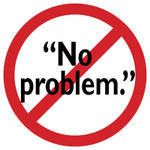
But my Number One worst pet peeve is how people constantly use “No problem” as the response to almost everything. It’s become a so trite, clichéd, unoriginal, and commonplace.
I knew I reached a boiling point when I saw this quote by the British author P.G. Woodhouse: “A slight throbbing about the temples told me that this discussion had reached saturation point.” Not only do my temples throb, but my brain screeches every time I hear those two words. And sadly, I hear them all too often. Cashiers say “No problem” after I thank them for the change I receive for my purchase. Waiters say “No problem” when giving me change from the bill I just paid. Front desk attendants say “No problem” after I thank them for giving me my room key.
What was the problem in the first place? What happened to the simple yet powerful phrases of “You’re welcome” and perhaps “My pleasure?”
It’s not just people in the service field who say it. I recently heard it out the mouth of a 6-year-old boy, and worst of all I’ve caught myself saying it. (By the way, if you ever hear me saying “No problem” please feel free to call my attention to it, if I didn’t already do it first.)
In many other languages, the customary reply to “Thank you” is not always a literal translation of “You’re welcome.” In French, for instance, the reply is “De rien,” which means, “It was nothing.” In Spanish, a common response is “De nada,” which means, “It was nothing” as well. In the U.S., Americans even use the slang “No problemo,” a bastardization of the more correct Spanish phrase, “No hay problema,” or “Ningún problema.” Is that where we get it? The more we hear and see the term used – even in movies — the more correct we think it is.
No matter how you slice it, in American English, to use the phrase “No problem” as the correct response to “thank you” and most other situations is not accurate. In fact, it’s inappropriate, in most instances inaccurate and in some instances rude. The correct response… one more time is “You’re welcome,” or “It’s my pleasure.”
Help Me Stamp out “No Problem”
I’m declaring a personal crusade to stamp out the use of “No problem” in our society. Henceforth, this subject will be a standard item in all my seminars and presentations, as are a few other topics, such as writing thank you notes. If you agree, please join me in a crusade to stamp it out. Here’s all you need to do:
1. Post a comment in the area below to show support of my efforts. I’d love to know I’m not alone.
2. Share your own stories about situations you’ve encountered where you heard the words “No problem” in lieu of what you think would have been a better choice of words.
3. Submit your own commitment to making every effort to eliminate these words from your writing and speech.
4. For parents and teachers: Educate and encourage your children and students on the merits of not using these words.
5. As an employer, share this article as something for your staff members to not use in front of your clients and customers.
If we all reduce the use of these words in lieu of other more appropriate words, over time it will become less and less common and appropriate to say. This is exactly how etiquette comes into effect.
Together we may be able to make a positive change in our society.
Happy Practicing!
I am with you on this one hundred percent . i think the reply of no problem lacks character and even self respect. But like you said , I even catch myself saying it sometimes which makes me want to shoot myself in the mouth. i was just giving a man an estimate over the phone.And he told me that he appreciated it and I responded with, you’re welcome. which I don’t believe is proparetic, in which led me on\nThis pursuit to see the proper response to ” I appreciate it”. and why am I on this form now. the fight against no problem is not a fight.You’ll have to fight alone, sir.I’m with you. Have a nice day.
Thank you for the positive comment. I appreciate it very much.
Come see more etiquette articles and join our happy family of worldwide subscribers who live learning about civility, etiquette, and manners at https://advancedetiquette.com/blog.
If there’s a problem I would let you know. If there isn’t a problem I will thank you for what you did.
Why would you chose to use negative words like “no” and “problem” over positive words like your “welcome” or my “pleasure”?
While the phrase “no problem” is intended to be polite, it contains two words that are inherently negative in construction: This can lead to different interpretations depending on the listener perspective or age
No problem is acceptable vernacular. The generations that use it outnumber those that don’t. Just because it offends your sensibility doesn’t mean you get to stop the natural progress of language. If I am saying “no problem” it means that helping you was of no inconvenience to me and thus your thanks are unexpected, undeserved and/or unnecessary. I do not expect thanks. I do not want to expect thanks. People who expect thanks are entitled and have a self-congratulatory attitude that is social sandpaper. Unless I’m doing something that is above and beyond and not expected per a social contract, your thanks is fine but unnecessary and I will continue to communicate this with “no problem.” And if that’s a problem to you, then you are the problem and I no longer need to speak with you. I’m so sick of boomers trying to tell people how to talk.
Rob: The way I see most word usage, languaging is all about displaying a person’s level of education. It has nothing to do with being a boomer. I now many Gen Z aged people who understand that most word choices isn’t “wrong.” It’s more about why say something that could be construde negatively, even if your intent wasn’t with that meaning, when there are other word choices that would be more universally accepted well. Happy Practicing!
Thank you very much for making this website and correct our English mistakes ❤. English is not my first language and it’s a bit difficult for me when it comes to choosing ” appropriate and more accurate ” words. I found your website when I searched about ” No problem ” it’s meaning and when should I use it.
I benefited a lot from this website.
Thanks!!
I wish my English will improve to your level one day .
I think the real reason most newer generations (with increasingly lower quality educational standards) don’t say “You’re welcome.” is that most of them are too ignorant to spell “you’re” the correct way. How sad!
I am tempted to respond to “no Problem” with “did I say there was a problem?”
Then why do you suggest there was a problem. I was taught at a young age was the normal exchange was Thank you……..you are welcome. Why does so many people quietly accept “no problem” as an acceptable response?
I grew up in South Africa and we have different ways to reply – it depends on the context or how grateful you are – ‘It was a pleasure’ or just ‘pleasure’ or ‘you’re welcome’ (my husband all the time). There are other times you would say ‘no problem’ if it was no trouble for you to help and you show that you are a person that helps anyways – doesn’t matter the circumstances. Very informal amongst some groups these days are: ‘sharp-sharp’ – which means no problem/no worries. When I arrive in the UK more than 20 years ago, I got to know all these other ways too – ‘no worries’ or ‘of course’. I don’t mind what people are saying. It doesn’t bother me at all. As long as you are kind and respond in a manner to show manners.
you”re 100% CORRECT! I cannot stand it either!! NO PROBLEM the most abused word in the history of the english langugage.
I refuse to say it I say My pleasure or You’re are welcome!
Yikes lol.
You’re welcome makes even less logical sense. Who poised that the thanker is not welcome? Why does this need to be affirmed. If you are thanking someone you probably caused them work. Saying no problem absolves you of this, which makes sense.
Feeling like you paid someone for the work doesn’t mean they owe it to you, either. It just shows a lack of understanding to think so.
I intensely dislike the answer to “thank you” being “no problem.” I want to query the person saying this with” Oh, did I say it was a problem.”
I agree with you, but “no problem” is nicely informal, while “you’re welcome” or “my pleasure” sound slightly stiff these days. I wish there was something else appropriate to say because, like you, I annoy myself by using this phrase!….
Interesting take. I didn’t realize we still used etiquette to justify one’s vocabulary and diction as superior to another’s, or a regional dialect. While etiquette is important in the context of some societal norms, I do not believe that it serves any purpose in policing dialects or personal vocabulary. Is it perhaps crass to use some idioms or conjunctive phrases, sure, but, is language dynamic? YES!
If the intent behind the speaker is friendly and considerate, I would argue their vocabulary does not matter. Are there specific etiquette for workplaces and professional spaces, absolutely, but this etiquette isn’t inherently codified by “Upper Class Vocabulary”, and is hardly different from consideration and respect for those and the space around us. I find it entertaining that this author speaks with authority on the dissemination of language with little linguistic credibility.
There is little attempt to understand the etymology of the phrase, yet the author is quick to judge and belittle those that use “No problem” as problematic. Here’s an enlightening article from Meriam-Webster on the topic.
https://www.merriam-webster.com/grammar/usage-no-problem
There is little difference between “You’re Welcome” and “No Problem”, if the question is one of sincerity and politeness. Apologies, but your article is a boomer take.
Doctors office receptionists use it ALL the time and its insulting to patients who are suffering illnesses and they keep saying “No problem.”
I feel the same way. Being from the Deep South , and being born in the sixties, manners were mandatory. “Yes ma’am , no sir, please, thank you, and you’re welcome”. “No problem” has become the normal response, in most all English speaking countries. I cannot get used to it, but it’s not going to change for ME. I guess I’ll continue to cringe when i hear it.
I don’t really like it either. It isn’t like I asked them to extract my tooth.
Get a grip. There is absolutely nothing wrong with saying “no problem” as a response to “thank you”. all you old crusty entitled nerds need to get off your high horse.
Hello Skooter:
I agree with your post. The purpose of the article was to highlight the sensitivity surrounding the use of the phrase “no problem.” In your example, responding to a thank you with “no problem” is appropriate, given the right scenario. Happy Practicing!
I might be “ a crusty older person” , however I am most definitely not a “entitled nerd” and don’t own a “ high horse” ( just regular sized ones). But I was raised to respect my elders. I’m so sorry
You weren’t given that opportunity. Try it, it’ll come back to you one day, I hope.
Couldn’t agree more mate. There is no place in this world to use codified language to gatekeep and marginalize. Boomers are wild.
this strikes me as you feel bad for being inclined to say “you’re welcome” because helping people doesn’t feel as natural to you, thus “no problem” doesn’t serve how you feel about helping people.
to you, helping people is earned and must be deserved, and you feel that “no problem” belittles the help offered.
in fact, thats the point of “no problem”. “no problem” s purpose is to make sure the person being helped knows they werent a burden to the helper, that it was no problem to help them.
“you’re welcome” is what you say when you want a pat on the back, it acknowledges that you did something for them, and thats it. no problem does both 1) acknowledging you did something for them, and 2) that you don’t need to worry about it being inconvenient. its superior in that way, because it serves both the person saying it and the person hearing it, assuming they’re a person who is cares about the helper.
another thing i noticed is the folks who prefer “youre welcome”, are the ones who say youre welcome instead of no problem. notice that people who say “no problem” aren’t annoyed about “youre welcome”. so many interesting little things to take in about this pedantic topic.
Hello Aaron: Thank you for your post. I appreciate when people take the time to share their thoughts on a topic. This is exactly what public discussions are meant to do. While they may seem pedantic at times, this is the essence of it, isn’t it? I share my thoughts, and you are doing the same. Happy Praciticing!
In the field of customer service, the phrase “No problem” can inadvertently convey a sense of inconvenience or a lack of genuine appreciation. Instead, opting for expressions like “You’re welcome” or “My pleasure” exudes warmth and gratitude, reinforcing a positive interaction. From my personal experience working in customer service, I found that using more appreciative language not only elevated the customer’s experience but also fostered a more respectful and engaging dialogue. For instance, when a customer thanked me for resolving an issue, responding with “You’re welcome” rather than “No problem” always left them with a smile, underscoring the importance of mindful communication in building lasting rapport.
Thank you for addressing the concept of “no problem” in etiquette! Your exploration of how this phrase can sometimes be misused or misunderstood highlights an important aspect of effective communication. I appreciate the examples and insights you’ve provided on how to navigate social interactions with greater sensitivity and clarity. This article is a valuable resource for understanding the nuances of polite conversation and maintaining respectful interactions. Excellent work on shedding light on this often-overlooked aspect of etiquette!
I feel that this reply, “No Problem”, to the expression,“Thank You”, is offensive and insulting. But just as important is the reflection on the person who uses “No Problem” as a reply. It makes that individual sound stupid, ignorant with bad manners and totally lacking in true appreciation of the recipient of this remark. But herein lies the real issue, those using this remark just don’t care. Thank God for more intelligent people who know to reply, “You are welcome” or “My pleasure”. Sad.
nah it’s just a u problem, I don’t get how it’s offensive
Robin:
Thank you for your message. I understand how it may not be clear why the phrase “no problem” can be considered offensive. It can indeed be confusing. I appreciate how this article has sparked such a discussion, which means you are now more aware of the issue. Please continue to pay attention to when you hear this phrase being used, so you can better understand when it is appropriate and when it is less so. Happy Practicing!
I’m not alone!
Another of my pet peeves is “you’re fine”. It’s almost worse than “no problem” . There are so many things wrong with both of these.
My go-to is usually “happy to help”.
I’m a customer service educator working for a large cardiac monitoring company. I tell all my students and trainees that nothing irks me more than hearing someone say “no problem,” instead of “You’re welcome;” I could not agree with you more.
I agree. If I thought it were a problem I would not have asked
In fact, the truth is exactly the opposite. The present generation, from all conversations I've had with them, states that they do not have to help people at all. They say that our generation, which uses these words of politeness is wrong in thinking that doing the right thing and/or expecting people to be helpful and kind is right.
I've had conversations with young people and they outright say that the use of "you're welcome" means they're pleased to help, while they actually might not be. "No problem" indicates a refusal to accept your thanks, and is more of a "yeah, whatever" comment. This "whatever" attitude is exactly what is wrong with the younger generations. It is noncommittal and leaves you unsure as to the exact meaning of their words, therefore you walk away with the belief that they simply couldn't care less about the customer, their job, or anything else around them. I have stopped doing business with places who don't know how to, at the very least, teach their employees some manners. While they may not have any once they leave their job, they should at least have them on the job, or they don't deserve my business. I can get the same attitude from a computer. This is why I avoid places like Wal-Mart, etc and go to family run stores.
I do agree that it's "generational". For generations people have been taught manners and have known how to behave in polite society correctly. I taught my kids how to as well. They are in their late 20s and early 30s. They still know how to say please and thank you. It's about how you're raised. If you raise your kids how to behave properly, that's what you'll get. If you raise them like animals, they'll behave like animals. My ex husband is an ex partially because he didn't know how to behave. Treat people with respect, not as if they don't matter, and we won't have the total decline of society like we do today. We're a mess because we are teaching our children that it's ok to be a mess. Stop excusing bad behavior. Expect more. Everyone doesn't get a trophy.
What’s more annoying than sayin no problem? NO WORRIES! I absolutely loathe hearing that phrase. I’m far from proper, but I always say thank you.
I am in complete agreement with you about this subject. My recent experience is this: we moved to a location with one restaurant. It is nice, except the regular food server there says "not a problem" over and over again. Last time we were there, I observed as she said this to every patron–I lost count at over 50 times. I don't know what is going on, but something is broken.
The response, “No problem or No worries” are phrases that have somehow been allowed to creep into the American vernacular. I find it to be too familiar, grammatically incorrect and insidiously aiding in the destruction of hearing the beauty of English spoken correctly. It is another way in which our society is abbreviating, not listening to what is being said or showing either their ignorance or their abilty to care. The proper response to, “Thank you” is quite simply,”You’re welcome or It’s my pleasure.” We are not asking if it was too difficult for them and are certainly not delving into what may be worrying about their job and if we were a part of the discord in their mental health.
Thank you notes are not only thoughtful, but serve to remind people of our own humanity. It does our soul good to acknowledge the importance of a gift, a kind deed or a special comment someone else has done on our behalf. It separates us from those who are lacking innate kindness and grace. Taking the time to write the Thank you note gives us a moment to focus on the goodness of other and that chain of kind thinking carries to the recipient who also feels good. It’s a way to spread good feelings and love and leads to a more caring society.
Etiquette is something that is necessary if this ever more crowded, violent and divided society is to continue on in peace and civility. Call a simple”Thank you” or “You’re welcome “ old fashioned; and, a Thank you note outdated and unnecessary , but it’s what makes us human. You see the person’s handwriting and that brings you closer. You know that someone was happy to help you and it makes you happy. When we all have a little extra happiness in our souls and feel closer to one another, it makes dissension and flip
Behaviors towards one another a little bit more difficult. It makes this world a little bit easier in which to live. Those two things are a small price to pay for a more peaceful community, County, State, Country or potentially, the world.
Dear Syndi,
I have great difficulty being on the receiving end of "no problem", during any type exchange between persons, even texting.
I just now explained to someone, via text, that I was involved with caring for my Mother's physical distresses and therefore too busy to speak over the phone.
The reply I received was, "no problem".
Sadly, this shows a lack of understanding on the other person's part.
I don't mind hearing 'no problem', but one that really grates on me is people saying 'nice to see you' instead of 'hi' or 'hey'. It's on the same scale as people saying 'good morning' as an auto-greeting in the office, but so much more irritating.
If you don't really mean it and are just using it as a random greeting phrase it feels false and condescending. "Yeah…um I'm here because it's my job, not because I came to see you." On the other hand, hearing it from a friend while visiting, etc is perfectly fine and feels meaningful since they actually are glad to see you and aren't just filling the air with office-speak drivel.
Not quite as irritating as one word texts like 'sup' or 'k', but still pretty bad. Just speak normally for godssake, and drop the fake bs.
Hello!
Thank you!
Thank you!
Thank you!
my husband and I question, "Why?" every time we hear, "No problem".
You helped us to understand why it is so unnerving.
Because it implies that there was a problem when I was thanking someone for what they did for me.
"Why would it be a problem?" is in my thoughts everytime!
You are most welcome. Glad you enjoyed my thinking on this topic.
I do not like "no problem" as it ends with *problem" and this is problematic.
I’ve always hated the expression & when I hear it I’m sure I have a sour look on my face, or at least wince!
I do not mean to be offensive however, for my purpose, this seems a little extreme. Change is one thing in our world which is constant. Like anything else languege will change with time. We should not be determined to beat it out any more than we are the modernization of cars. Though I can understand why a person might feel this way in regards to their view on ettiquete, it seems it is more subjective then objective in view. Thank you.
This bad example of saying “No Promblem”. Is a way for young people to say that , I don’t care what you think, a rebellion of respect for their elders. Many times I have to correct people younger than I am, to not call me by my first name. If I don’t give you permission to do so. I still put a handle in front of peoples names, some younger than myself, I also ask them, how I should address them. People would get along better if they put others before themselves. When we send out cards to jobs etc. we don’t send out No promblem letters, we have enough sense to know. “ Thank you”, is thee appropriate reply.
I say “No problem” or “Not a problem” when helping others such as my boss or people I work with to reassure them that whatever the issue, it’s not a problem that can’t be fixed. I enjoy providing this reassurance and I’ll keep enjoying my use of the phrase “no problem.”
Keilyn: Your post is right on. There are times when saying no problem or not a problem is appropriate. Your example is among them. Thanks for sharing.
No pr ( I don't want to type it) it becoming a throw away two word phrase. Some will say it without thought. Recently a company had made a mistake and then even at the end of the call they said ' no problem ' . I told them the phrase is as inappropriate given the situation. Is it about the situation or the person saying they haven't got a problem ? I mean life is full of problems and well….so what ? It's part of being alive.
Thanks for taking the time to
post your perspective. It’s becoming a hotter topic.
The most annoying, trite and unoriginal words are: "assome" and "my friend." It's like a desease that everyone caught and sadly reflects a hive society. Don't be one of the herd!
Hello James: thanks for your post. From my perspective, and based on some
“What I think are misspelled words, I do believe the use of certain words as fillers can be like a disease, i.e. “you know” and “right” with each sentence, and saying awesome and perhaps “me and my friend” do equally drive me up a wall. I continue to ask: why can’t people choose to speak in proper and appropriate language and words? It is a sign of lack of education and care.
That’s it for today on this topic. Thank you.
My most painful encounter with "no problem" was this: A former high school student of mine, by that time in his 20s, asked to use me as a reference on a job application. I happily consented. However, when the potential employer phoned, he was more interested in hiring me (in addition to my former student). We made an appointment for me to go to his office and talk to him. I drove about 30 minutes, and when I arrived he wasn't even in the building. I phoned him and told him we'd made an appointment, he was not there, and he'd wasted over an hour of my time. He cheerfully said, "Not a problem!" as if I had done something wrong and apologized to him!
I am 100% with you, Syndi.
I shared your article on LinkedIn, the only social media I engage in.
https://www.linkedin.com/posts/elena-chang_saying-no-problem-is-not-proper-etiquette-activity-7086442008482902016-U_Vt?utm_source=share&utm_medium=member_desktop
It’s an uphill battle, but we shouldn’t give it up!
Thank you for the campaign
I agree with you entirely and just had a long discussion about this with my teenager on this topic. What I find similarly inappropriate and disturbing is the use of “no worries.” Under my breath I usually répond that I “was not worried to begin with. »
Hello Julie: Thanks for the comment. There is a time and place for everything. To say ‘no worries’ is a phrase I used recently when a person forgot to call me at a time we had arranged. I was working away and didn’t realize the time until 15 minutes later, myself. When I called her, she was most apologetic, and my response was ‘No worries.’ In this instance, I believe it’s appropriate to use this phrase because I truly didn’t want her to be concerned I was upset with her and might hold a grudge. There are far fewer situations “No problem” is ever appropriate to say.
I am with you 100%. I go through a drive-thru and the person hands me my food, I say "thank you" they reply with "no problem" I say, "I should hope not."
I get looks of confusion.
Saying "no problem" in lieu of saying "you're welcome" implies that it would have been an inconvenience or a problem to provide you with the service you are paying for at their establishment.
I see it as a breakdown in politeness and manners in what should be a civilized society.
Incidentally, my personal campaign is, conscious word choice. Imagine what the world would be like if everyone made the effort and make conscious word choices before opening their mouths. Conscious Word Choice, feel free to pass it on.
Michelle: You have made my day with your comment… Thank you! I, too, believe in Conscious Word Choice, meaning to care about using correct, precise, and accurate words whenever speaking and writing. Often people choose the wrong words because of not being properly educated in knowing the true definitions of specific words… i.e. conscience vs. conscious.
I agree! No problem infers that one may not have deserved the help, but you did it anyway. My response to “no problem” is “I didn’t think it was” or “I hope not”.
Thank you for taking the time to submit your comment. It’s all about the appropriateness of when to say, no problem.
When someone is asking for something difficult or inconvenient but the person wants you to know it's not really difficult or inconvenient such as asking for a favor it's appropriate to say "no problem".
Cheryl: The intent of this article is not to say “never” use the term no problem; rather use it appropriately. In your scenario of asking or doing something difficult, inconvenient, or asking for a favor, would be appropriate to say no problem in response to a thank you shared. Again, it makes no sense to say no problem when receiving change at the checkout counter. Thank you for taking the time to ask.
Oh thank goodness, I thought it was just me! It has bothered me for way too long and when I hear it I usually say something like “oh i know, I didn’t think it was a problem” while getting a blank stupid stare like “what?” But, I do approve of it when I ask for a request that is separate or different or extra, and they say no problem, I’m cool with that.
About 30 years ago, I worked at a place that was visited by then Prince Charles (now King Charles III). I somehow found myself in the receiving line as he entered. He greeted
each of us as we were introduced said a few words to each person. When he reached me, he apologized for the fuss that had been made for his visit. How did I respond? NO PROBLEM. And 30 years later I still don't know what came over me at that minute!
Good Lord. "No Problem" is a more than acceptable response to "Thank You"
The Kindness someone did for you wasn't a problem or an inconvenience.
JacobS: What you have written may be true from your thinking. However, the whole point is why choose to have habits of using words/phrases that may have negative meanings? Instead, we all should strive toward only using the most positive and accurate words when speaking that can never be misinterpreted. Thank you!
Wow. Get over yourself.
AMEN BROTHER
Here's what's worse. We've come to the point where we, the customers, are thanking service people for helping us. It's supposed to be the other way around.
As the customers, they should be thanking us for our visit. That's how it used to be. That's why it's all turned around. How often do they? It's so rare.
When I make a purchase, I should immediately hear, "thank you!". Instead I hear, "have a nice day" or words to that effect. They should be grateful for my patronage. The fact that I shopped there, ate a meal there, or whatever, helped them keep their job.
They should say "thank you" and I'll say "you're welcome".
The only difference is if I ask to see something for something and they hand it to me, or a waiter puts down a plate in front of me.
I can't believe I have to explain simple etiquette, but it's really because no one teaches it at home or in school any longer.
I'm am so much in agreement. I wonder what happened to common courtesy and I often find those offensive because no problem is used to counter and apology or for making special requests. Recently I got a blood donation call to schedule an appointment. After a time was found the rep on the phone said No problem." I hadn't made a special request, apology or imposition. I asked her she said "No problem." I'm offering a service of giving blood. I just think people are not trained to be service-minded or professional in a service setting. There is no common courtesy in our society. I don't hear from BloodWork "Thanks for your donation." Instead, the worker concludes the appointment with "no problem." It's just so awkward.