
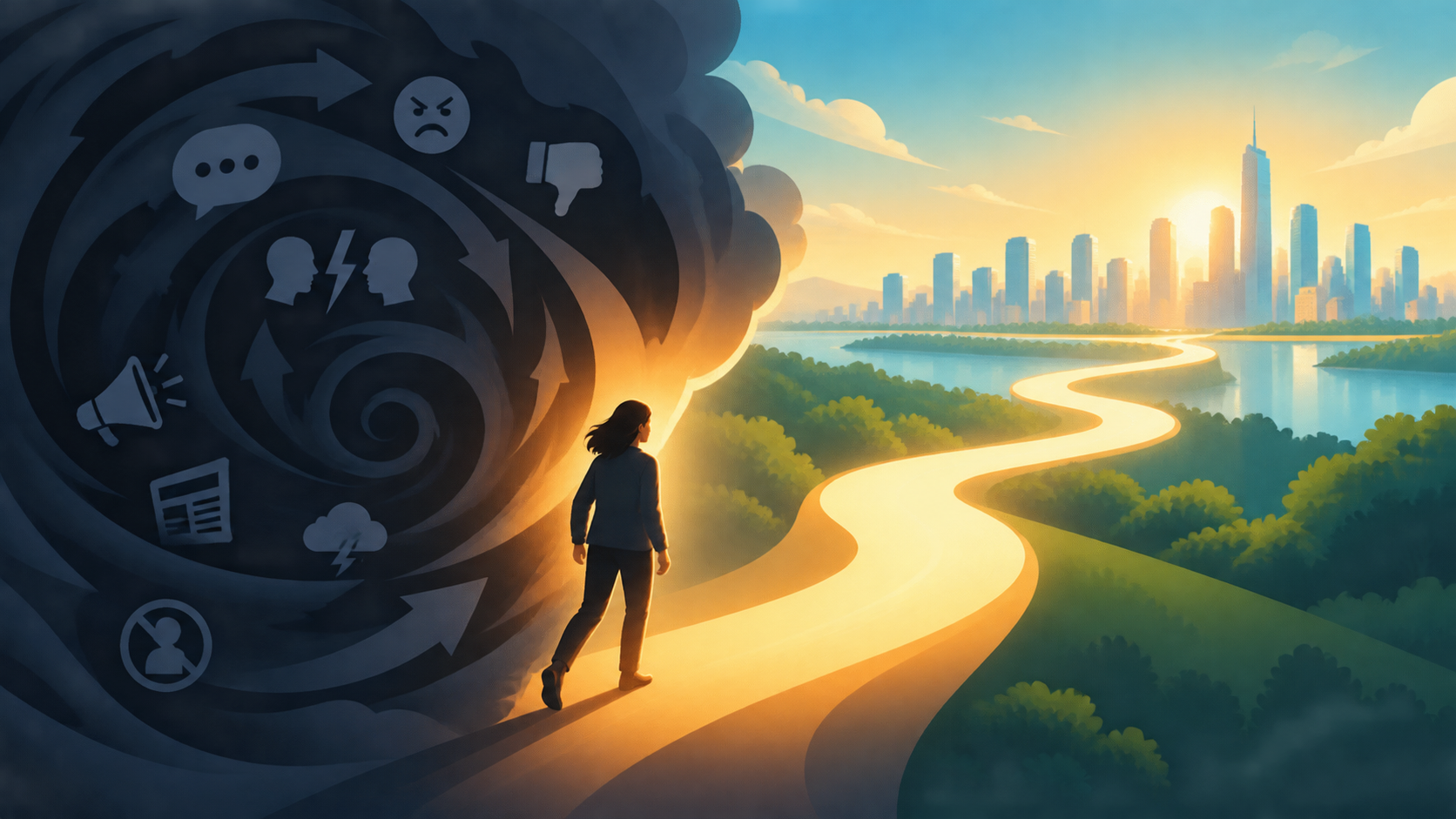
The Negativity Spiral: How Snap Judgments Undermine Us
We're living through the fastest-changing period in human history. New technologies emerge, global conflicts simmer or erupt, and weather patterns defy history. Through it all, one thing threatens us faster than any other external force: our own impulsive negative behavior.
I feel it too. All this change is driving me crazy. We humans thrive in stability. Decades of research confirm we cooperate and progress better when life feels safe and predictable. Yet stability is vanishing, leaving us uncertain. With uncertainty, we retreat into complaint and blame.
But we have a choice. We can adapt with resilience. Too often, we choose the former, and it's accelerating our own decline. Here are some thoughts on the subject to consider:
1. We perpetuate the wrong responses. Scroll on social media, and you'll see the same script: Something changes, and the first reaction from people in your feed is a complaint. "The new software is confusing." "AI will destroy jobs." Perhaps you trust these people, so you’re interested in their take.
Rarely do we pause to ask: What problem is this solving? What's my role in making this transition smoother? Snap judgment replaces thoughtful evaluation, and we just nod.
We all know Edison invented the light bulb. What we forget is that when asked about his thousands of failures, he said: "I have not failed. I've just found 10,000 ways that won't work."
Imagine if our thinking about this innovation was that Edison’s bulb failed again and again. We could think the same way about the Wright Brothers, who crashed far more than they flew, or Henry Ford, whose companies went bankrupt twice before revolutionizing transportation. Progress has always required a long runway of failure.
Actually, we humans don't lack the capacity to adapt. What we lack is the discipline to think before reacting.
2. Our impulsive negativity can easily compound. In an already unstable world, we're navigating technological advances that outpace our ability to adapt, geopolitical conflicts that destabilize regions, and climate volatility that disrupts food systems and infrastructure. It’s too much all at once, so it’s easy to just shut down and shrug.
3. Worst of all is our communication breakdown. Even though we’re in our most connected era in history, we're more polarized than ever, and less able to hold productive dialogue.
Two forces drive these impulses toward negativity: Nationally, studies show that students' reading scores have declined. This weakens their ability to process complex information and think critically. Adults are not doing much better. We retreat into algorithm-fed feeds that confirm our biases rather than challenge them.
The result is a population that listens and hears less, understands less, and consumes less through the narrow lenses we choose. We do it all while feeling more informed than ever, but we avoid those who don't share our views. Doing so leads to isolation.
In our downhill spiral, instability breeds fear; fear breeds negativity; negativity breeds resistance; and resistance breeds more instability. The irony is, we can rebuild stability only through adaptive thinking, not defensive reaction. We cannot out-negative our way into a stable future.
How to move forward
If negativity is the disease, accountability is the cure. We need to move away from blame directed outward to responsibility owned inward. It starts with accepting that you are either part of the solution or part of the problem. There is no neutral ground.
A few accountability tips to follow:
- Pause before judging. Ask what problem the change was designed to solve before rejecting it.
- Separate signals from sensationalism. Seek balanced reporting, not just the scariest headline.
- Celebrate iterations. Failure isn't the opposite of success. It's part of the process.
- Communicate to understand, not to win. Engage in an opposing view with curiosity, not combativeness. Listen to learn new perspectives.
- Take personal ownership. Ask daily: Did I add stability or instability today?
Multiplied across millions of people, this kind of accountability is the only mechanism powerful enough to counteract global instability. We can't control wars or weather, but we can control our responses in every area.
We Choose Our Trajectory
History's greatest advances came from failure, patience, and forward motion, not from demanding instant perfection. If Edison had listened to negativity, we'd still be sitting in the dark.
The question isn't whether change will keep coming. It will. The question is whether we meet change with fear, thus deepening our spiral. Or can we meet change with accountability and positive engagement, becoming the stabilizing force this world needs? The choice is ours. Positivity and accountability are, in the end, good etiquette.
P.S.
I have a new assistant: Francis.
Since I started writing newsletter articles nearly 20 years ago, I’ve written each one from my own thoughts and experiences, using the Internet for factual background. My editor since the start, Dianne Jacob, has helped me shape these ideas into cohesive articles.
Now, I’ve added a new team member I’ve long dreamed of having, named Francis. He is a skilled collaborator who helps me produce a cohesive first draft, which I then edit into my own words and style. Ultimately, Dianne adds her magic to finalize the article and make it sound its best.
Francis is here to stay, like the internet and the light bulb. I wish we humans could embrace and manage all innovation wisely, including AI, without fearing its growth or abandoning our responsibility to guide it to its greatest potential. I know that when we use AI thoughtfully and ethically, it amplifies what makes us human. It does not replace us.
The future isn’t something that happens to us. We shape it, one choice at a time.
BTW, if you haven’t already guessed, Francis is the name I gave my new AI assistant, collaborator, and partner. It was my husband’s middle name, who truly was my first copy editor.
P.P.S.Since 2023, many have warned that AI poses an existential threat to humanity. [See https://www.nytimes.com/2023/05/30/technology/ai-threat-warning.html]
I believe in a deeper truth: Our own negativity and inability to communicate with one another pose the greatest risk if we don’t learn to get along civilly. This is truly humanity’s greatest existential risk.
Happy Practicing!