
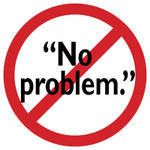
 Do you have one or more words or phrases you can’t stand? I do. Among them is the word “further” instead of “farther” when talking about distance. Another is common on signs in stores, saying “10 items or less” when it should read, “10 items or fewer.”
But my Number One worst pet peeve is how people constantly use “No problem” as the response to almost everything. It’s become a so trite, clichéd, unoriginal, and commonplace.
I knew I reached a boiling point when I saw this quote by the British author P.G. Woodhouse: “A slight throbbing about the temples told me that this discussion had reached saturation point.” Not only do my temples throb, but my brain screeches every time I hear those two words. And sadly, I hear them all too often. Cashiers say “No problem” after I thank them for the change I receive for my purchase. Waiters say “No problem” when giving me change from the bill I just paid. Front desk attendants say “No problem” after I thank them for giving me my room key.
What was the problem in the first place? What happened to the simple yet powerful phrases of “You’re welcome” and perhaps “My pleasure?”
It’s not just people in the service field who say it. I recently heard it out the mouth of a 6-year-old boy, and worst of all I’ve caught myself saying it. (By the way, if you ever hear me saying “No problem” please feel free to call my attention to it, if I didn’t already do it first.)
In many other languages, the customary reply to “Thank you” is not always a literal translation of “You’re welcome.” In French, for instance, the reply is “De rien,” which means, “It was nothing.” In Spanish, a common response is “De nada,” which means, “It was nothing” as well. In the U.S., Americans even use the slang “No problemo,” a bastardization of the more correct Spanish phrase, “No hay problema,” or “Ningún problema.” Is that where we get it? The more we hear and see the term used – even in movies — the more correct we think it is.
No matter how you slice it, in American English, to use the phrase “No problem” as the correct response to “thank you” and most other situations is not accurate. In fact, it’s inappropriate, in most instances inaccurate and in some instances rude. The correct response… one more time is “You’re welcome,” or “It’s my pleasure.”
Help Me Stamp out “No Problem”
I’m declaring a personal crusade to stamp out the use of “No problem” in our society. Henceforth, this subject will be a standard item in all my seminars and presentations, as are a few other topics, such as writing thank you notes. If you agree, please join me in a crusade to stamp it out. Here’s all you need to do:
1. Post a comment in the area below to show support of my efforts. I’d love to know I’m not alone.
2. Share your own stories about situations you’ve encountered where you heard the words “No problem” in lieu of what you think would have been a better choice of words.
3. Submit your own commitment to making every effort to eliminate these words from your writing and speech.
4. For parents and teachers: Educate and encourage your children and students on the merits of not using these words.
5. As an employer, share this article as something for your staff members to not use in front of your clients and customers.
If we all reduce the use of these words in lieu of other more appropriate words, over time it will become less and less common and appropriate to say. This is exactly how etiquette comes into effect.
Together we may be able to make a positive change in our society.
Happy Practicing!
Hallelujah! Finally, "no problem" is getting the attention it deserves. It should be struck from the language. My teeth grind every time I hear it!
If I am having a polite disagreement with someone, and we come to terms, a kind "no problem" is a good way to move on. But as a substitute for the appropriate 'You're Welcome" is both rude and sometimes condescending.
Thank you for shining light on this annoying and common bit. Now, if someone would please tackle the elimination of "I'm like", as a substitute for "I said", I will be very happy indeed!!
But I am afraid that Elvis has left the building on that one!
Hello Mark D: I truly appreciate your post. You’ve made my day… Thank you!
Correct Finaly N Happy crusade to the No Probs No Problemo No Problema n NO PROBLEM in fact in my opinion No Problem has become a Problem in of itself As person with Dyslexica there ate mire creative n correct ways Starting with the simple Say no Problems in its context not as a thanku or you're Welcome As mentioned My Pleasure Or you are welcome Most Welcome. Its lazy way of speaking
Hello Fayb: Naturally, I agree. Thank you!
I respond with “oh I didn’t think it would be a problem!”
Isabel: Thank you. I’ve also heard people saying, “Thank you.” I’m glad there wasn’t/isn’t a problem.”
Who is P.G.Woodhouse?
Dave: “Sir Pelham Grenville Wodehouse [not Woodhouse], KBE was an English author and one of the most widely read humorists of the 20th century. Wikipedia. He wrote one of my favorite fictional comic characters, Jeeves, who was a phenomenally wise butler in English society, and who always knew best what to do.
I think we have lost this battle. I am 85 and a retired editor. I have to face the fact that almost everyone is younger than I am and they mostly say "no problem." Get used to it! Let's fight for "fewer than"!
Miriam: Thank you for your post. As a senior citizen, myself, the battle over saying less or fewer is equally a battle many people do not understand its proper use because it is not being taught.
I agree.
The problem with saying “no problem” is that it seems to convey that, if it is NOT said, the expectation is that there IS a problem. This is a very negative outlook.
Paul: Thank you for the comment.
I like, of course when it’s not a problem
Nige: That’s it! Why say, “no problem” when it’s not a problem in the first place. Thanks for writing.
"No problem"? Clearly that isn't the case, because you have a SERIOUS problem. You think that being a cold, transactional critic is polite.
When you say "you're welcome" you are indicating that someone else, or in other circumstances, they might NOT be welcome to your help, or even to ask for it. You are saying that it is only because you are deigning to be gracious that they can ask a favor.
Helping other people should be a perfectly routine thing, always. When someone asks for help with something, and I am able to give it, that is literally "not a problem", and when I say so, I am reassuring them that is ALWAYS the case. Responding to the entreaty of another is not a perk I bestow upon them, it is my duty to my neighbor as a Christian (or any ethical person, really), and they should never worry, or fear that they are problem.
Christian: Your comment is well taken for the situation you’ve described. Saying “not a problem” is different than saying, ‘no problem.’ The example cited in the article on when not to use ‘no problem’ as the response for the check-out person while giving change to a customer at a grocery store is still an appropriate response. Thank you!
No Problem is perfectly acceptable. Whatever the action was, my response was perfectly within the pervue of things I felt I could do in assistance.
Had there been some problem, I would have chosen not to help. Do not ever ask me if there was a problem before unless you really need to hear that again.
Generally, I speak English, and others. The others are all sort of second languages as I sometimes make mistakes when I forget a word in one language and accidently substitute a third language. As Spanish is one of my 'others', sometimes I do occasionally reply ningun problema when someone has the good grace to say thank you.
Most of the time though I tend to reply "no worries". This is in reponse to either 'Thank you' or the newer trend in 'I appreciate you'. Either actually seems to be an acknowledgement of some expenditure of effort, which is appreciated on my part.
"No worries" usually means I would do it again if needed. Do not see why anyone would have a problem with this sentiment.
So true, and a huge, sad, issue on "Lawn Guyland" NY.
"NP": The motto of the doomed and brainless.
No manors.
No sincerity.
No creativity.
No future.
Sad.
Very sad.
Lawn Guyland sad.
I loved your writing and all the comments,
I experienced this 'no problem' everyday at my workplace with one of my colleagues, at the end of the conversation with him, he finished with no problem, english is not my first language and still I noticed, I wondered why he's saying that? it sounded to me inappropriate, disconnected and out of place, than I pointed out at him in a friendly way..oh I know when you want to end the discussion and show that you are disinterested..you say no problem, and he answered again like a machine: no problem..
later I fell into the habit, I caught myself infected by using it.
I agree with Haifa saying: "It’s a colorless meaningless word that does not really tell the other person what you think or how you feel.So it distorts communication."
Please if you can make an article about the usage of "isn't it" where I work in London uk, people use it at the end of every sentence when they talk and it's nauseating..,
maybe I am wrong but this tells me their narrow way how they see things, looks like they dont leave place for other opinion but assume for you to automatically agree with what they are saying "innit" NO IT IS NOT YOU SELFISH IDIOT, and the worse of it, they are employees at the customer's service, they say innit and leave, the same people who ask or express their rude way of greeting..you ok ye?
Thank you
I completely agree. 'No worries ' also makes me furious. I first encountered this from my assistant at work. I was simply thanking her for her help. I suddenly discovered that my request for help could have caused a inconvenience/worry/ problem for her when she responded ' no worries'!
Thank goodness!
I thought I was the only one!
I agree
I absolutely agree with you that when someone replies "no problem" to something that I never felt was a problem or burden to begin with, it absolutely makes me bristle. However, that doesn't mean the phrase is never appropriate. I suppose in situations where a possible problem was averted, it could be used. And whenever a young person tells me "no worries" I actually feel good. I think that one is very reassuring. As an older person (54), though, neither phrase is commonly used by me, and I have no difficulty saying "You're welcome," and find it hard to comprehend why young people find that so awkward. On the other hand, I disagree with you that "De rien" and "De nada" are comparable to "No problem". IMO those are very gracious. To say "it was nothing" is just to imply that the favor or task performed was relatively insignificant or no trouble at all. I think that's what the users of "no problem" are trying unsuccessfully to convey, but to me it would be much better if they simply said "It was nothing" or just say "De nada" even to an English speaker. Everyone knows what that means.
Irene: Thank you for taking a moment to write your post. Keep writing any time.
I was so relieved to read your post. I am vindicated. Chick-Fil-A has a great customer service training program–the best! I am the next "guest" and I never hear the response "no problem". It is always their pleasure to serve me. The difference between a couple of words is powerful.
When I hear the response "no problem," I respond, "WHEW! I'm so relieved I didn't cause any problems for you."
Another phrase that bites me? "It is so cheap!" Not cheap! "Reasonably priced" or "affordable."
Thank you for your post.
Joan: Thanks for the post. Another word to add to your list to counter the word cheap is inexpensive or less costly. Keep the posts coming!
Personally, I think you're over re-acting a bit. I'm not sure if you're an English major and desperate to apply some of what you've learned to your reality or simply are much more sensitive than others.
While I appreciate that you want to adhere to proper English, I'll offer two small defenses.
"My Pleasure" is largely associated with the food chain Chick-Fil-A (because that is the required response by employees) and in America is more of a reference than an actual response. Almost a joke now?
"You're Welcome" just sounds oddly formal in most retail situations and can come out very sarcastically very easily.
Anyway, maybe take a trip to the spa and find something else to get so worked up over. 🙂
Marie: Thank you for taking the time to write.
Posts of any kind are meant to share points of view. No defenses are needed. You have your opinion and I have mine. In writing this article, I was merely sharing my thoughts on this topic and respect your thoughts to be posted, as well. Happy Practicing!
I agree, I will also try to stomp out "No Problem" as well. However I do use it, so it will be hard, but worth it. FYI, try not to put "Happy" in front of words, sounds like people are trying to hard to seem happy. Happy Friday, happy Tuesday. Yeah, doesn't work for me. Happy Thanksgiving, Happy Easter, Happy Valentine's day, sure, part of what we know. But to add it to Happy practicing, be more original. Liked your overall message though, please don't take me wrong. Thank you for the article.
DJ: Thank you for taking the time to write. Regarding the use of Happy Practicing, it’s a phrase I’ve used since starting the business over 20 years ago. If you agree Happy Thanksgiving, Happy East, and Happy Valentine’s Day are appropriate, it is from this perspective I am wishing a person a happy time in celebrating practicing etiquette skills, regardless of how known it is in the universe. For those who follow my work, you are now a part of our happy family of subscribers who believe in Happy Practicing! All the best!
Iam in agreement with you,I was wondering why I’d feel so Irritated after some said “no problem “
I agree. It questions why others say this … as it becomes a problem for me !!
It makes it sound as if a favor was done for you when usually it is a paid duty that the person is responding to. Returning change is due to one by a paid employee shouldn’t elicit the No problem … I think we either can directly inform the person or just know that they mean You’re Welcome; either tell them or post signs or just ignore it.
It bugs me, too, to no end; Stamping it out needs to begin in English Class.
Thanks; hope you encounter no more problems.
Betty: Thank you for the post. All I want is for folks to think about the words they use to be the most accurate and appropriate to every situation in life. There are a handful of situations saying ‘no problem’ could be appropriate. However, and regrettably, more times it’s used less appropriately which is why I wrote the post. Happy Practicing!
No Problem! LOL
What if someone says, "I'm sorry I bothered you" — isn't it ok to say, it's never a bother or not a problem.
The definition of "problem" is: a matter or situation regarded as unwelcome
So when someone apologizes, it makes perfect sense to say: Not a problem.
Jillian: Yes, you are correct, it does depend on specific situations whether ‘no problem’ is a correct response. The example you’ve shared is an appropriate response. Thank you for asking.
I was once told by an employer to never say No Problem, say My pleasure! That stuck with me, I also say, Absolutely, or Of Course. I've heard my teenage daughters say NP, and I had to have a talk with them about it, lol! I also hate No worries!
Laura: Thanks for the post. I’ve not yet thought about ‘No worries.’ It, too, falls in the category of what’s appropriate, depending on the exact situation. Overall, NP and NW are used, all too often, inappropriately. Happy Practicing!
I'm nearly a decade too late to this party, but I would like to disagree vehemently with the assertion that "no problem" is an unacceptable response to "thank you":
Language changes. In fact, language changes with or without your support. We grew up with "you're welcome" as the correct response. But if most people today agree that "no problem" is an acceptable response, then it is an acceptable response, and you'll save yourself a lot of frustration if you accept it as well. Either phrase conveys the same, very low amount of information, and primarily serves the conversational, rather than literal, purpose of acknowledging a "thank you". So at the end of the day, what difference does it make?
Incidentally, in my view the phrase "no problem" is a shortened form of "it was not a problem", meaning that the favor did not pose a burden for the speaker. To say that the phrase implies that there is a "problem" that ceased to exist only when "no problem" is uttered is not a correct interpretation; the use of the past tense brings it in line with the customary replies to "thank you" in other languages. The phrase "thank you" conveys indebtedness, so if the favor was truly not a burden to you, then it is polite to inform the recipient of that favor, in the hopes of easing this feeling of indebtedness. This has the additional benefit of reserving the phrase "you're welcome" for more heartfelt situations where an acknowledgement of a stronger "thank you", in turn acknowledging a bigger favor (one that involves much more effort than, say, handing someone a room key at a concierge desk), is required. I believe this more open mindset is better suited for the language of today.
Hello John: I appreciate you taking the time to submit comments on this post. While your points are well-received. Perhaps the deeper response is, it all depends on the situation whether ‘no problem’ is appropriate or not. Happy Practicing!
I feel the same way. I totally dislike the comment but I thought it was me
To be honest, I was not aware about the term “No Problem” until when I landed in Canada for my PhD. At the first time when I said thank you to someone and I heard “No Problem” I felt offended a bit. This happened again and again and gradually I felt normal about it and I used it in my own words too. Now, out of curiosity I searched about it and It was interesting that my sense about it was not so wrong 🙂
I had the same experience. I learnt something new today. Thanks.
Dear Syndi,
I thank you for your article re: No Problem. Better late than never?
I have felt this to be rude all along. Sadly, the people saying it are kind, generous, caring—decent people. I believe they are unaware of the rudeness of the expression. They are also unapproachable on the subject for the few times I’ve attempted it made me the bad guy!
Perhaps it’s that too many polite people smile in your face and then weasel and swindle or otherwise pretend to trust without authenticity as in commercial promises often unfulfilled? Then wary customers see a “problem” about the markets. Then maybe they become cynical and change “you’re welcome” into “not a problem”?
Still, returning evil for evil is no good way. Again, I’m glad I found you. And again I am grateful for your article.
Warmest regards,
T. Meyer
Sarasota, FL
Finally!!! Someone gets it. I have been telling my wife this for years. I am glad I am not alone. Your quote of “what was the problem in the first” is something I find myself asking others. I feel like telling the waiter “lf it is not too much of a problem can you…” Thank for posting!!
I agree with you 100% and am on board with your crusade.
The problem is implied. It’s the service you elicited which required you to feel obligated in the first to thank them. The reason any language states it’s nothing, is to tell you, that the implied problem which was just dive for you, and for which you are thanking them for, is not a burden, and therefore does not exist. I would say no problem is a correct response, if not a little lazy or slightly dudesque. But “it was my pleasure”? Come down from your ivory tower…
How do you feel about “No worries”? Thanks.
Stephanie: “No worries” as with “No problem” have their place as good phrases to use… as appropriate! The purpose of this article was to recognize it is not to be used in “all” situations.
Oh, I am very much in agreement with this. I loathe when some young silly thing says this back to me after serving me. OF COURSE it’s “no problem” – it’s YOUR JOB! I ALWAYS respond with “you’re welcome” or “my pleasure” and do you know what? People actually almost do a double take as they’re hearing a much more genuine and warm term from, unfortunately a different time and (gasp) it ACTUALLY makes them feel better.
Now DO NOT get me started on people who serve me slamming my credit/debit card back onto the counter (next to my out-stretched hand), after I have actually placed it into THEIR hand to start off with.
Blood boiling!!!!!
The question and were brave enough to mention the word “etiquette” in public. Living outside the US for many years the english language has become a pigeon language ; pigeon is now a formal language in Hawaii . “Folks”instead of Citizens, ladies / gentlemen and ” you’re welcome” is too personal. Excuse me has been replaced with ” no problem” or a hand sign instead. As a writer word mangling is like slashing the Mona Lisa, but “not a problem” when texting..
Thank you for the info and folks like you dare to utter that the problem is not using words to connect IS the problem
Oh my, I found your article because I couldn’t stand one of my colleagues who always responds me with “No Problem” instead of “Thank you” when I had given her work related suggestions. Perhaps she felt it was cool saying that but for sure it drove me crazy.
I bet “You’re welcome” makes more points in a job interview than “No problem.” Speaks volumes about how candidates would treat customers. Think about how those in the hospitality indystry always say, “My pleasure.” Makes me feel important.
Thanks for sharing your thoughts about what are binary
options forex. Regards
I have an employee who when given an instruction always responds with “no problem”. Or when you catch him bending some rule and you give a little slap on the wrist the answer still is “no prob”. I am expecting “got it” or “I’m sorry”.
Has it never been considered that when a person speaks, you should aim to recognize what they mean? Has it never been considered that, in non-academic, informal settings, a temporary adoption of contemporary semantics is often necessary to effective and harmonious communication? Has it never been considered that the purpose, and utter definition, of ‘pleasantries’ is thoroughly true to its etymology? Consider it! A simple exposition of pleasant feelings toward another—what unadulterated beauty!
I believe it is true: to pursue peace and humanity is to pursue understanding and acceptance. It is to understand and accept others based upon their adherence to. Absolutely! Reject words of hate and slander! Reject even your own! But REJOICE in others’ thoughts, words, and acts of kindness. In a world of greed and egotism, they are veritable bounties of love and goodwill.
Never shall I justify intolerance, but I shall always justify intolerance for the intolerance of well-meaning others. Truly, such a derisive attitude toward honest acts of kindness is absolutely detestable.
If you want to come off as respectful, “You’re welcome”, with a smile is perfect. You helped someone. Welcome the warm fuzzies, cause you did good.
Now if your friend said, “Yo, Dude! You’re the man!” After you gave him free tickets to a game”, maybe, “No problem!”, “Anytime!”, “You know who loves you'” would be appropriate?
I too have been bothered by the response of “no problem” since I started hearing it used so often, and usually in the customer service industry. If I ask a server for ketchup for my hamburger (just as an example) the last thing I would expect to hear is the Hated response of NP. Of course it’s not a problem, it’s your job!
It was my job for many years, how about:
Right Away, or My Pleasure or Certainly. It has always implied to me that it COULD be a problem, but right now it isn’t . Oh I hate it so much, it makes my blood boil I shall join your movement and post to my FB, it’s got to stop people, it’s just so wrong!! Nice to know that I’m not alone. Thank You.
Patience, tolerance, and understanding are desirable traits. I would rather be around people that mean well and use phrases that are grammatically incorrect than be around people that are so uptight that they are immediately judgmental about every word you say and take them out of context.
I choose not to respond with “No Problem or No Worries” because to me, it implies that there was a problem or that someone was worried (and the words aren’t very uplifting). I usually respond with “Thank you”, but, depending on the situation, I might respond with: “Of course” or “Anytime” or “You bet”.
I do feel that what is most important, is that the “Thank You” and “You’re Welcome/No Problem/No Worries” are sincere.
I am truly thankful when I say “Thank you”. I really mean it and am not expecting any kind of “You’re welcome” in return.
Just want to say your article is as surprising. The clarity in your post is just great and i could assume you’re an expert on this
subject. Fine with your permission allow me to
grab your RSS feed to keep up to date with forthcoming post.
Thanks a million and please keep up the enjoyable work.
You never explained how it was incorrect. I do not understand at all how it is rude or even an incorrect response. It’s no different than saying it was no trouble to you for you to help out or do whatever kind thing you did. It’s basically saying you don’t mind or basically that you are willing to do things like that for them at any time. I don’t know if they are taking it from Spanish, but I think it makes perfect sense in English as it is. Also why are you okay with things that have the same meaning or portray the same idea in other languages but are not okay with that used in English? This really doesn’t make sense to me.